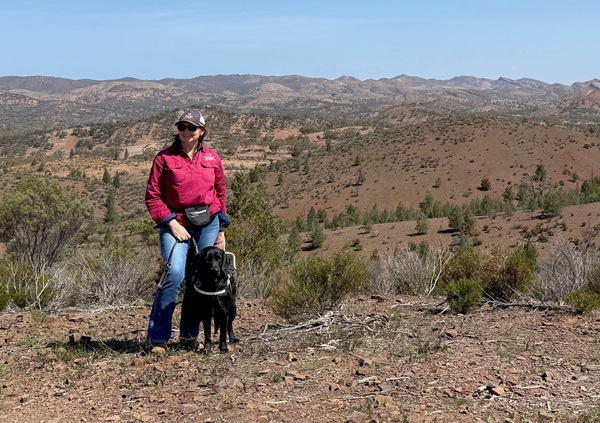
Not only has Mika adapted to different environments, she’s also quickly become used to Tarina’s career as a physiotherapist.
“She spends a bit of time in the clinic with me, and she settles in really quickly. I would say nine out of 10 of my patients don’t even know she’s there under the desk unless she yawns or something like that.”
While Mika has worked in places many Seeing Eye Dogs may never visit, Tarina said the biggest impact has been the everyday support Mika provides.
“I’ve always been a very active and independent person and when my vision deteriorated, I found that I was very reluctant to go to new places. It was also getting quite dangerous; I was covered in bruises from bumping into things and catching myself on doorknobs.
“I probably should’ve been using a cane more than I was, but I just didn’t really take to it. I also didn’t want to have to have someone come with me when I was out getting the groceries or that sort of thing, so a Seeing Eye Dog just seemed to be the option for me to maintain my independence and that’s what Mika has done.”
The pair’s partnership has proved so effective that people often mistake Mika for a Seeing Eye Dog in training.
“Particularly when I’m in the city people will often see us out and about and ask if I’m training her and they’re quite surprised when I say I’m not.
“One of the things I did find when using a cane was that it was slowing me down a bit, but with Mika I’m able to walk very upright and quite quickly, which I love. I’ve actually had to do some work with Brooke, our instructor, to slow down so my husband can keep up with us.”
With Tarina and Mika only new to their partnership, Tarina says she’s excited about what the future might hold.